Skip to content

Choosing between an electric vs non electric bidet becomes straightforward once you put bathroom logistics ahead of feature hype. Every decision boils down to two separate questions: what power and water connections your bathroom can safely support, and which daily comfort functions—warm wash water, a heated seat, adjustable spray controls, or warm-air drying—matter enough to justify them.
Below, we walk through the three real-world setup paths—ambient non-electric, dual-temperature non-electric, and electric powered seats—so you can rule out incompatible options in minutes. Where we cite Elecbidet Series 3 specifications, they reflect our Chinese AC 220 V / 50 Hz reference manual to illustrate how powered controls operate, rather than defining local electrical codes for every country.
Check Bathroom Power and Water Feasibility First
Before comparing spray modes or seat styles, take two minutes in your bathroom and confirm three physical basics:
- Electrical outlet availability: Electric bidet seats require a properly grounded, moisture-protected bathroom outlet (such as a GFCI or RCD circuit, depending on your region) within reach of the power cord—for reference, Elecbidet’s 330 manual specifies a 1.2 m cord length.
- Cold and hot water access: Every bidet seat taps the toilet’s cold-water supply line. If you have no outlet and want a dual-temperature non-electric seat instead, you also need an accessible hot-water supply (usually under an adjacent vanity sink) and a model specifically engineered for dual supplies.
- Side clearance and bowl fit: Measure the gap between the toilet bowl and nearby cabinets or walls, especially if you are considering a seat with an attached side-control panel.
Keep “nearby” separate from “compatible.” An outlet across the sink or a hot-water valve inside a closed vanity does not automatically guarantee a clean, code-compliant installation. When adding a new bathroom circuit or routing a hot-water branch, have a qualified electrician or plumber verify the work before you buy the seat.
Three Practical Bidet Paths Compared
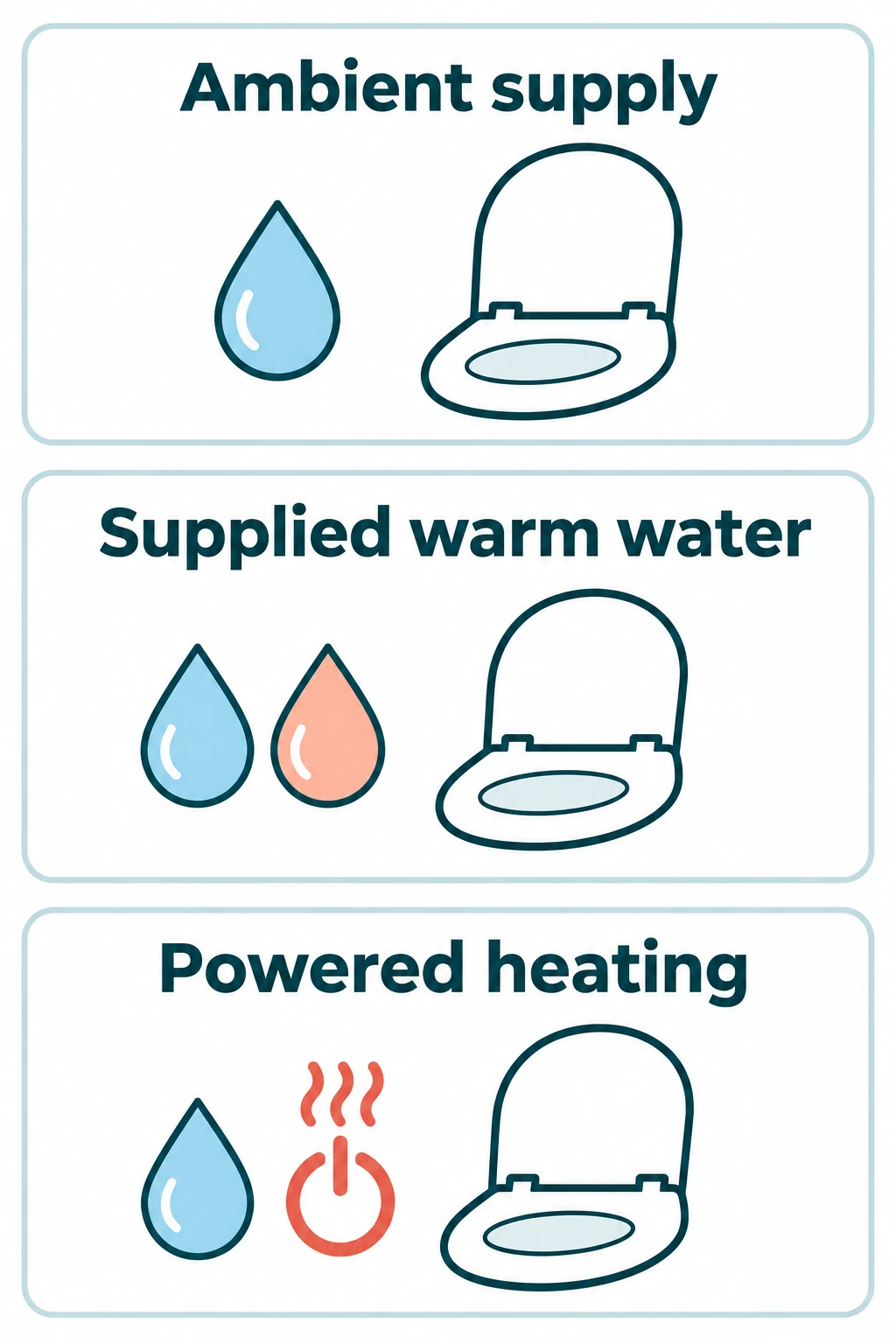
Many buyers assume “non-electric” automatically means icy tap water all year round. In practice, non-electric describes how the seat is powered, not a single water-temperature category. Some dedicated dual-temperature non-electric seats accept both cold and hot lines and blend them mechanically via a mixing valve—without heating water inside the seat. However, never connect an ambient-only non-electric seat to a hot-water supply; its internal seals and valves are not rated for hot household water.
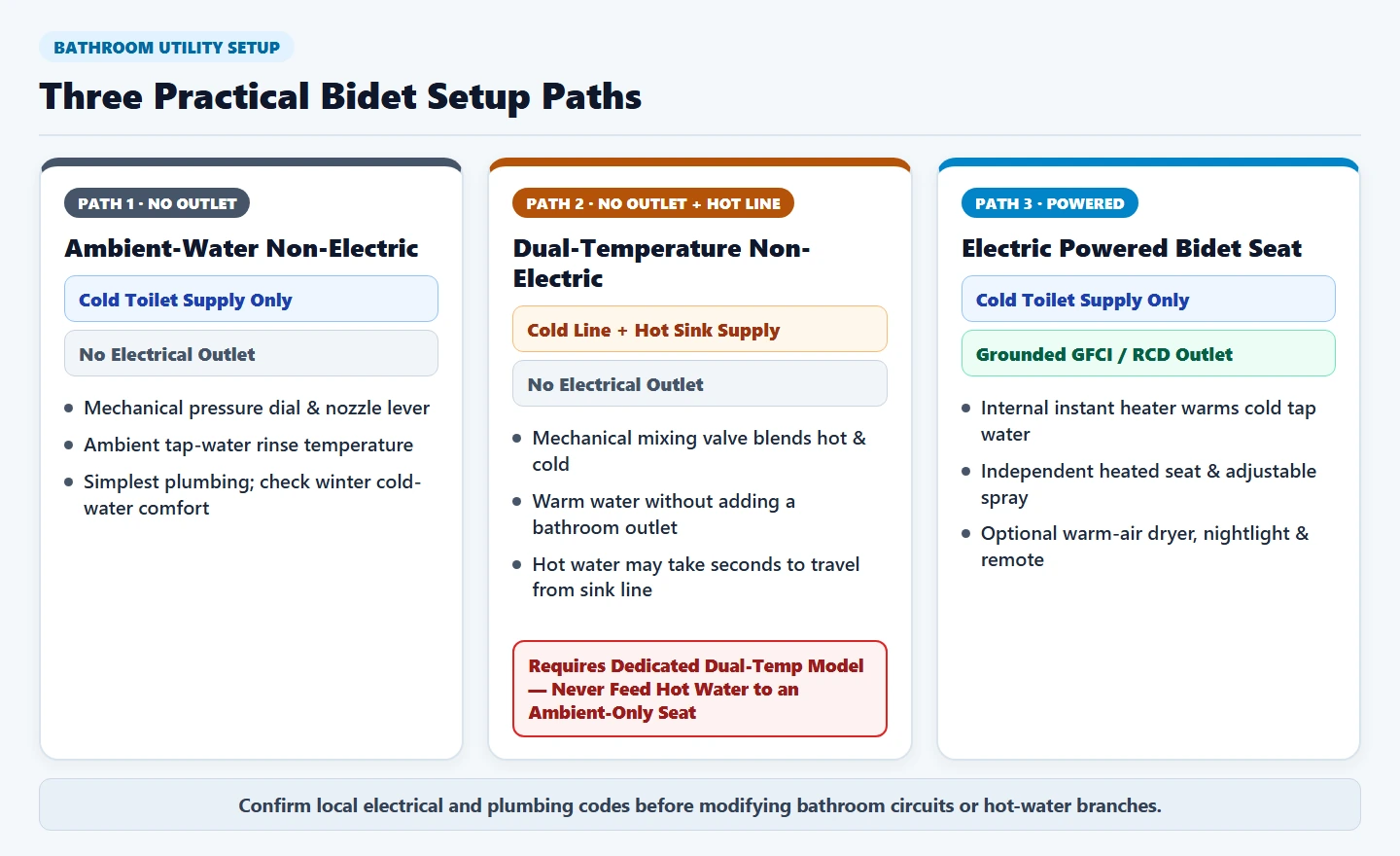
| Setup Path | Power Needed | Water Supply | Core Comfort Functions | Key Constraint to Verify |
|---|---|---|---|---|
| Ambient-Water Non-Electric | None | Cold toilet supply only | Mechanical rear/front rinse with manual pressure dial | Comfort with seasonal incoming cold-water temperature in winter. |
| Dual-Temperature Non-Electric | None | Cold supply + external hot-water line | Mechanically blended warm rinse without an electrical outlet | Model must explicitly support dual supplies; hot water may take seconds to arrive from the sink pipe. |
| Electric Powered Bidet Seat | Grounded GFCI/RCD outlet | Cold toilet supply only (heats water internally) | Internal warm wash, independent heated seat, adjustable flow/position, optional warm-air dryer and nightlight | Outlet reach, destination-market voltage match, and right-side clearance for side-arm controls. |
What an Electric Bidet Seat Actually Adds
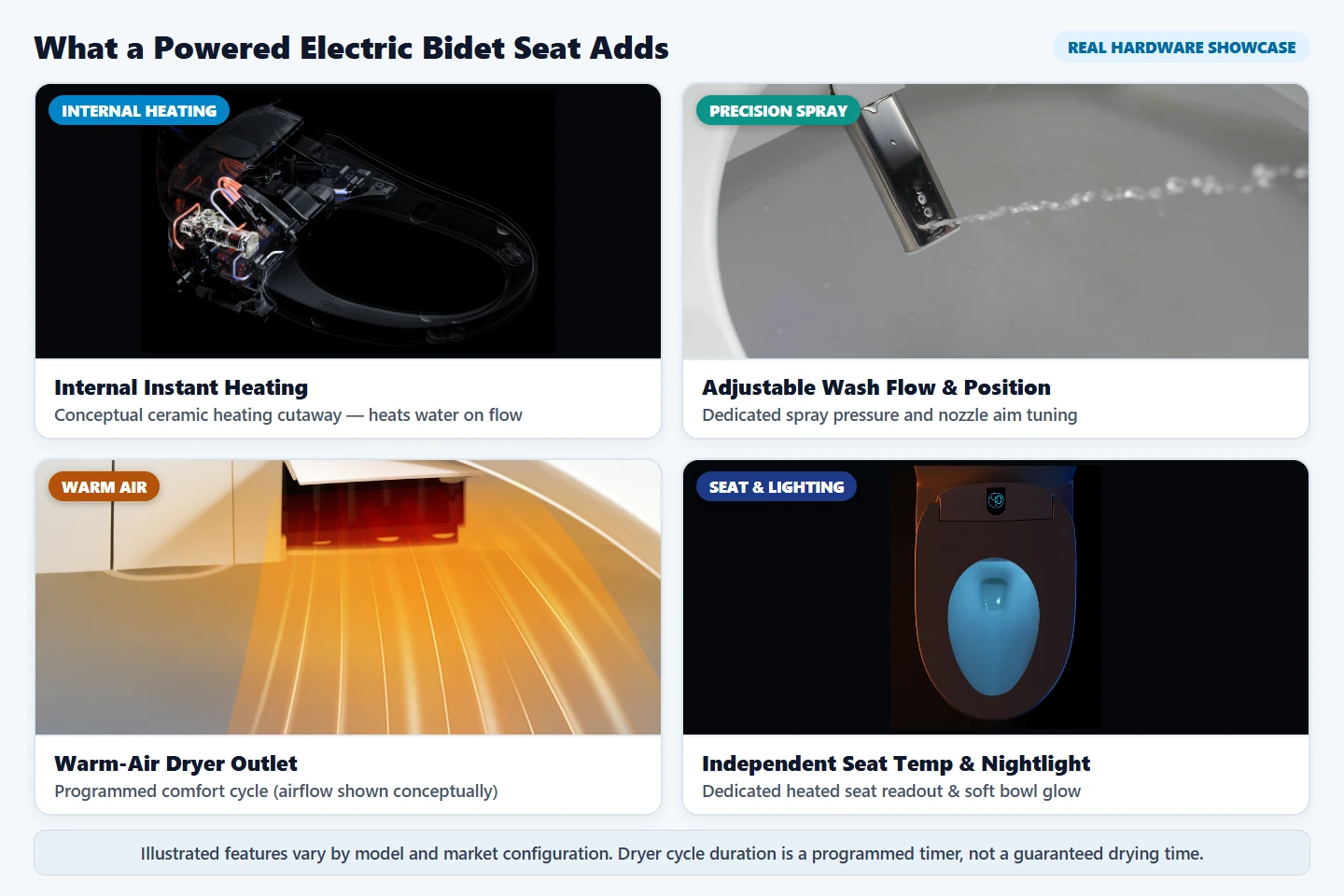
An electric seat does more than simply warm water—it separates each part of the routine so you can tune comfort independently. Using the Elecbidet Series 3 Standard (with its 330 Chinese 220 V / 50 Hz reference manual) as a concrete engineering example, notice how four distinct comfort controls work without interfering with one another:
| Daily Comfort Need | How a Powered Seat Handles It (Series 3 Standard Reference) |
|---|---|
| Consistent Warm Washing | Direct-feed instantaneous heating warms cold tap water inside the seat as it flows (approx. 0.5–0.8 L/min). A dedicated water-temperature key cycles ambient, low, medium, and high (up to approx. 40°C) independently of the seat and dryer. |
| Independent Heated Seat | A separate seat-temperature key lets you pick ambient, low, medium, or high (up to approx. 40°C). You can keep the seat warm on winter mornings even if you prefer a cooler rinse, or turn seat heat off in summer. |
| Precision Spray & Position Control | Dedicated Rear and Front wash keys start cleansing (pressing again activates oscillation), while separate + / − wash-flow buttons and nozzle-position arrows tune pressure and spray aim independently; Stop halts any active cycle. |
| Warm-Air Drying | Starts via its own dryer key or automatically after an Auto wash cycle, with four air-temperature settings (ambient to 55°C measured 5 cm from the outlet, 4–7 m/s). Its documented 180-second timer is a programmed cycle length, not a guaranteed time to complete dryness. |
Keep expectations realistic around drying: a heated seat does not imply a built-in dryer, and a built-in warm-air dryer does not mean every household stops using paper overnight. Many users prefer a quick blot before or after warm air—see our practical guide to drying after using a bidet for everyday routines that balance comfort and speed.
Side Panel vs. Wireless Remote: Matching Controls to Your Space
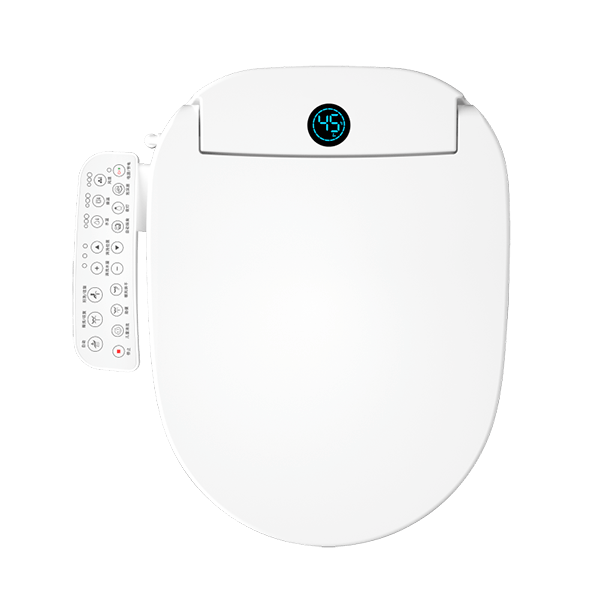
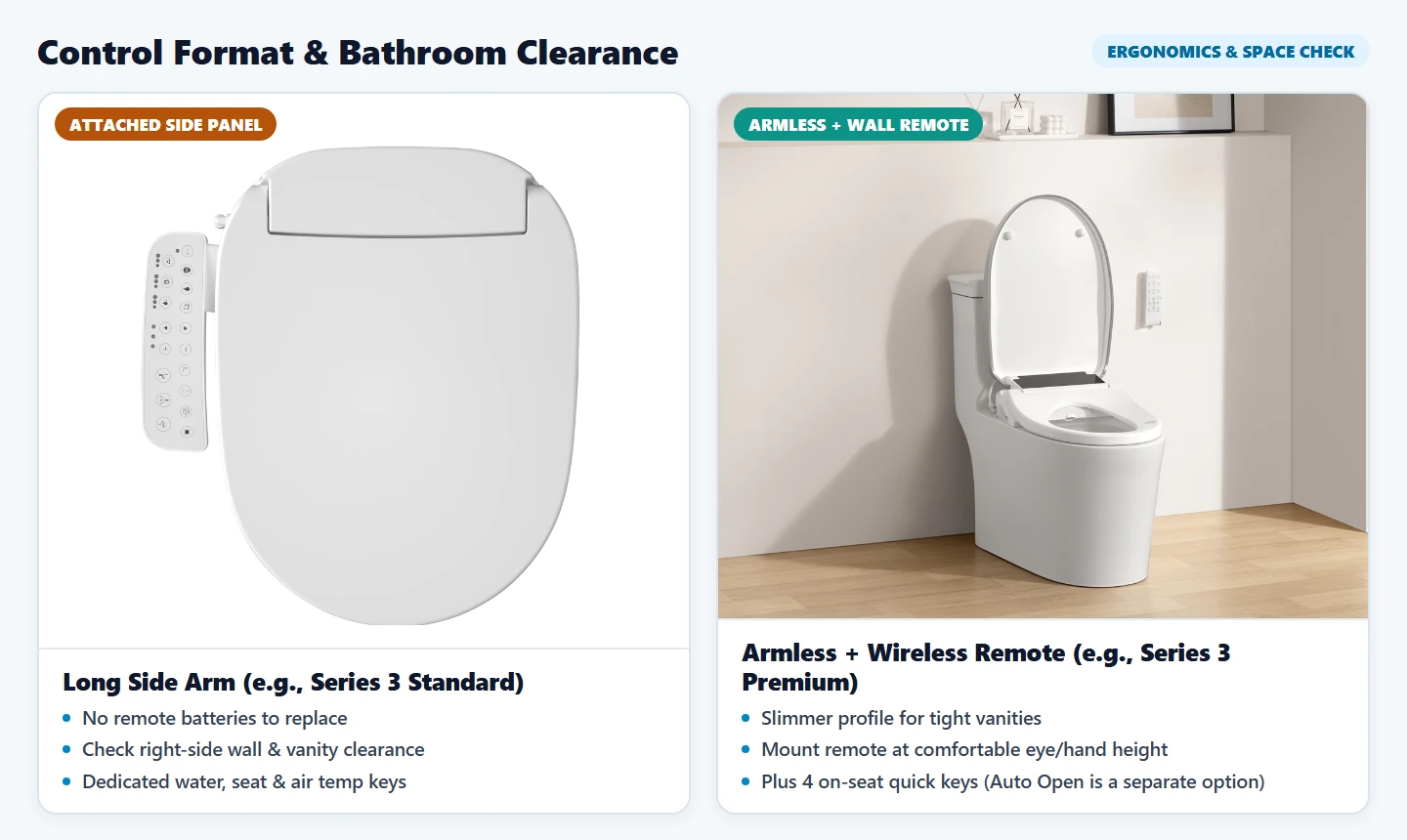
Once you decide on an electric seat, control ergonomics make a bigger everyday difference than most buyers expect. A fixed long side panel—like the Elecbidet Series 3 Standard—keeps every button permanently attached with zero remote batteries to replace, making it reliable for guest bathrooms or households that dislike misplacing remotes, provided there is comfortable clearance beside the bowl.
If a vanity cabinet sits tight against the toilet or users prefer reading buttons at eye level, an armless remote seat such as Series 3 Premium solves the clearance issue cleanly. It pairs a handheld wall-mountable remote with four on-seat quick keys (rear wash, front wash, Stop, and drying). On the remote layout, an energy-saving mode can turn seat heating off when desired—a helpful pairing to read alongside seat-temperature settings, though it does not guarantee a fixed annual energy-saving percentage. Note also that having a wireless remote does not by itself imply automatic lid opening (Auto Open is a separate Premium configuration distinction) or mobile app connectivity.
Step-by-Step Decision Checklist
- Eliminate unsupported setups first: If no grounded outlet is feasible and you cannot add one, focus strictly on ambient non-electric or properly plumbed dual-temperature non-electric seats.
- Separate warm water, heated seat, and drying: List each function individually so you do not overpay for extras you will not use—or skip a heated seat you will miss every winter.
- Choose side arm vs. wireless remote by clearance: Measure right-side vanity space and think about who will reach and read the controls.
- Verify bowl shape and destination voltage before ordering: Confirm elongated vs. round fit, valve fittings, and local electrical specifications.
Ready to compare electric configurations side by side? Explore the Elecbidet smart bidet seat range, or contact our team if you need market-specific electrical and plumbing specification sheets.
Frequently Asked Questions
Can a non-electric bidet provide warm water?
Yes—if you choose a dedicated dual-temperature non-electric model and connect it to both a cold line and an accessible hot-water supply. It blends external hot water mechanically rather than heating water internally.
Is it safe to connect a standard cold-water bidet seat to a hot-water line?
No. Ambient-only non-electric bidet seats are built for cold tap water; feeding hot household water into them risks scalding and valve or seal damage.
Do electric bidet seats require a dedicated bathroom outlet?
They require a properly grounded, moisture-protected outlet (GFCI/RCD) matching the model’s voltage and load requirements. Check local electrical codes and consult a qualified electrician if an outlet must be added.
Does an electric bidet seat with a warm-air dryer eliminate toilet paper completely?
Not for everyone. A built-in dryer reduces reliance on paper, but a programmed cycle (such as 180 seconds) does not guarantee complete dryness for every user; many people combine a quick blot with warm air.
What is the main difference between a side-control panel and a wireless remote model?
Side-control panels need no remote batteries and stay attached to the seat, but require extra right-side clearance. Wireless remotes leave the seat armless for tight spaces and let you mount the controls at an easy-to-read wall height.
How do I know if my toilet fits an electric bidet seat?
Measure your bowl shape (elongated vs. round), mounting-hole spacing, tank-to-bolt clearance, and the distance from the mounting holes to the front rim, then verify those dimensions against the candidate seat’s fit template.