Skip to content

To clean a bidet seat, use a soft cloth, controlled moisture and cleaning materials permitted for the exact model. Treat the outside surfaces, spray wand and filters as separate tasks. A procedure that is suitable for the seat lid may be wrong for a nozzle, control panel or water-inlet part.
Start with the care instructions for your exact model
Find the model number and its maintenance section before starting. Identify the permitted cloth and cleaner, the power precautions, and any instructions for extending and retracting the wand. Keep those task-specific steps together.
For ordinary surface cleaning and seat removal, the Brondell CL1700 manual calls for unplugging the seat first. Wand-cleaning functions need their own instructions: some use powered controls. Do not unplug and then pull the wand out because a cleaning button no longer responds. If the instructions seem inconsistent, ask the manufacturer to confirm the sequence before proceeding.
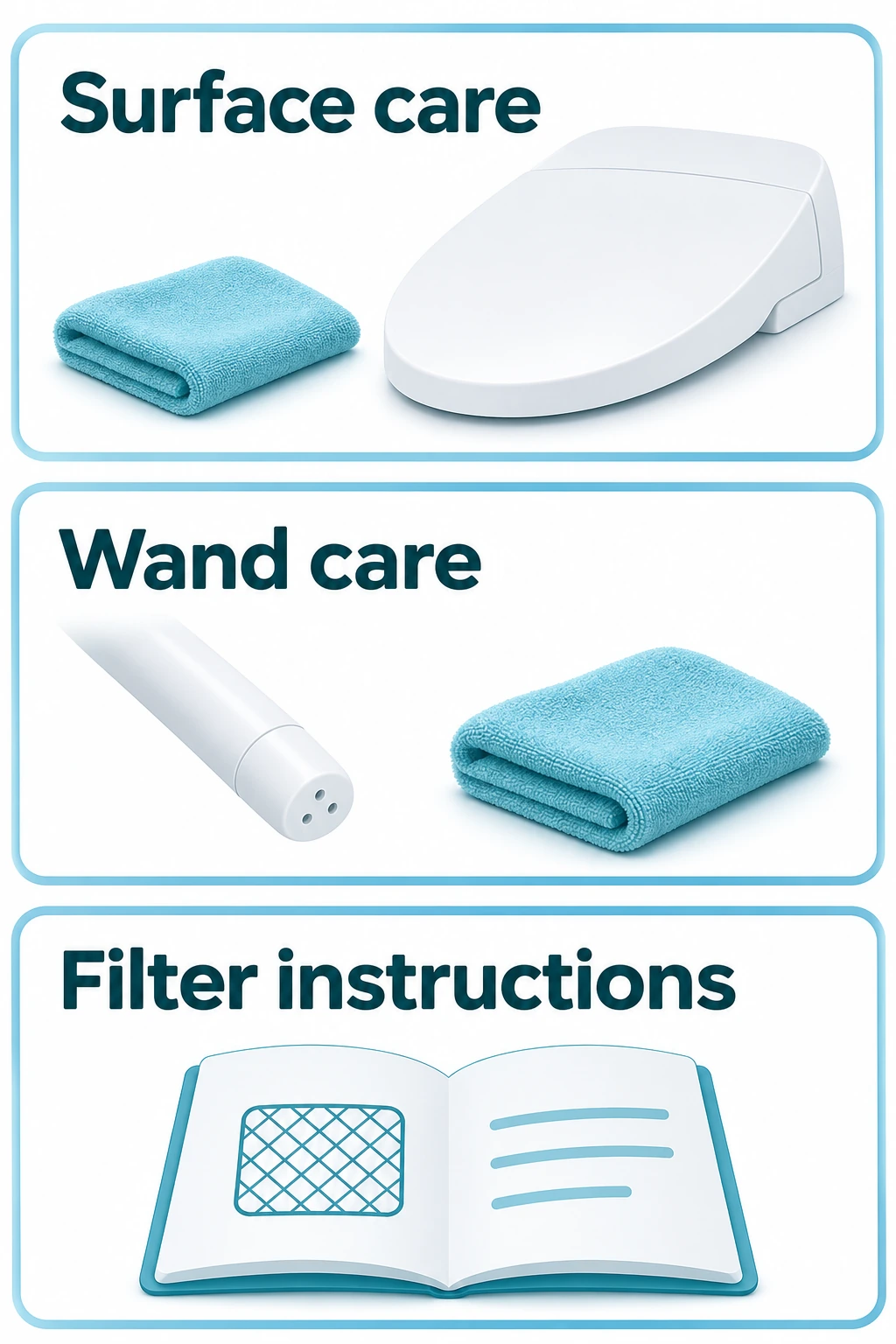
Clean the seat and lid gently
Once you have prepared the seat as its instructions require:
- Use a soft cloth dampened with water and wrung out well.
- Wipe the permitted exterior surfaces gently, without scrubbing pads or abrasive powder.
- For remaining dirt, use only a cleaner the manufacturer permits for that surface. Remove residue as directed.
- Keep liquid out of openings and gaps; do not hose down or soak the appliance.
For a manufacturer example, section 7 of the 330 manual’s Chinese AC 220 V / 50 Hz edition specifies exterior care with the power disconnected. Wipe with a soft, thoroughly wrung damp cloth. Only for heavy soil, put a small amount of diluted neutral bathroom cleaner on the cloth, then remove residue with a clean damp cloth. Keep water out of the product; do not shower or otherwise rinse the main unit or control panel. These are exterior-care instructions for that manual edition; check that it matches your seat.
The TOTO C200/A200 manual, for example, specifies a well-wrung soft cloth for the main unit and diluted neutral kitchen detergent for heavy dirt, followed by a water-dampened wipe. That is guidance for the listed models, not approval of a cleaner for every bidet seat.
Avoid choosing bleach, vinegar, alcohol or a homemade mixture simply because it is used elsewhere in the bathroom. Check the seat’s own permitted materials. If a mark remains, seek model-specific advice instead of increasing the chemical strength or scraping it away.
Treat nozzle care as a separate task
A self-rinsing nozzle does not mean every owner-care task disappears. Brondell’s care guide discusses nozzle, seat and filter care separately; the appropriate access method depends on the product.
Find the built-in wash wand in the parts diagram for your exact model, then look up its maintenance instructions. The 330 manual offers one model-specific example. Use the parts diagram and care instructions that match your seat’s version.
In the same 330 manual, wand care is a separate powered task with version-specific instructions. The section notes a PRO exception to wand extension but does not give an alternative PRO extension method. Use the procedure for your version; the exterior power-off instruction does not supply the steps for powered wand care.
Use the documented maintenance mode or access method for your wand. Clean only the accessible areas with the permitted material, then follow the specified retraction method. Do not push, pull or twist the wand to overcome resistance. Do not transfer another brand’s button sequence or nozzle-cap removal method to your seat.
Check filters and removable areas only as instructed
Use this task map to decide which instructions you need before going further:
| Area | What to confirm |
|---|---|
| Water-inlet filter or screen, if fitted | Whether it is owner-serviceable, how to isolate water and power, and whether to clean or replace it. |
| Deodorizer filter, if fitted | Its separate care method; do not assume it is washable or uses the water filter’s schedule. |
| Under-seat area | Whether removal is supported, how to release and refit the seat, and how to avoid straining attached hoses or cords. |
Record the manual’s maintenance schedule and your last completed task rather than applying one cleaning interval to every part. Before normal use, complete the specified refitting and checks. If there is damage, leakage or an electrical symptom, stop the cleaning task and seek service guidance.